


What is the Dialogic Method?


What is the Dialogic Method?


The Dialogic Method is a framework that draws on the disciplines of mediation, cognitive psychology, behavioural change and systems thinking to help varied end-users harness dialogue towards different purposes, with the goal of creating multiple, sustainable outcomes.
It is

1
Dispersible
That is, it is a framework that does not require any specialized knowledge, making it easy to understand and apply. This in turn allows for the method to be used easily, and be applicable to a wide range of situations.
Versatile
Most problem situations in structured situations have a resolution mechanism in place. However, there is no system to address problem situations arising in unstructured situations. The DM framework is built to be applied to problem-situations that arise in both structured and unstructured interactions amongst samaaj, sarkar and bazaar.
Multi-Functional
That is, it can be used to achieve a wide range of outcomes that include but are not limited to managing conflict (prevention, transformation), building consensus and community mobilization, collaborative problem solving, all of which lead, in the longer run, to a change in cultures and systems – particularly with regards to how we see, respond to and behave in a conflict situation.
It is

Dispersible
That is, it is a framework that does not require any specialised knowledge, making it easy to understand and apply. This in turn allows for the method to be used easily, and be applicable to a wide range of situations.

Versatile
Most problem situations in structured situations have a resolution mechanism in place. However, there is no system to address problem situations arising in unstructured situations. The DM framework is built to be applied to problem-situations that arise in both structured and unstructured interactions amongst samaaj, sarkar and bazaar.

Multi-Functional
That is, it can be used to achieve a wide range of outcomes that include but are not limited to managing conflict (prevention, transformation), building consensus and community mobilization, collaborative problem solving, all of which lead, in the longer run, to a change in cultures and systems – particularly with regards to how we see, respond to and behave in a conflict situation.
The
Framework
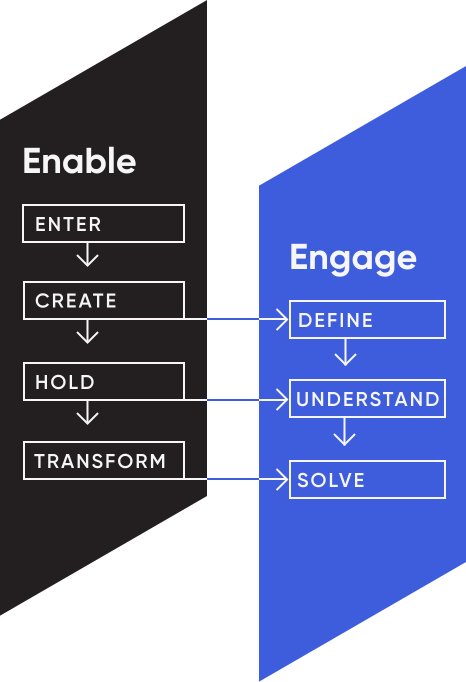
Focussed on core principles of value creation (as distinct from value distribution), emphasis on self-determination of participants to ensure crafting of inclusive and sustainable solutions, and harnessing the power of a non-binary approach, the Dialogic Method framework lays out steps for individuals, organisations and communities to Engage (participate in) and Enable (create and hold spaces for) dialogic solutioning across a spectrum of situations.
The
Framework
Focussed on core principles of value creation (as distinct from value distribution), emphasis on self-determination of participants to ensure crafting of inclusive and sustainable solutions, and harnessing the power of a non-binary approach, the Dialogic Method framework lays out steps for individuals, organisations and communities to Engage (participate in) and Enable (create and hold spaces for) dialogic solutioning across a spectrum of situations.
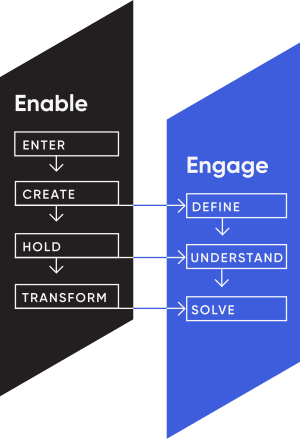
Engage

Define
Identifying the dimensions of the problem situation by mapping out the problem (WHAT), the underlying interests and motivations of the parties (WHY) and the stakeholders involved in and impacted by the situation and its effective resolution (WHO).
Understand
Moving towards creating effective information flows and exchange of perspectives with a view to harness the potential inherent in diverse and multiple perspectives, while managing the affective/emotional element involved towards building and preserving relationships between the parties.
Solve
Generating, evaluating and actionating solutions options with emphasis on self-determination,value creation and a non-binary attitude towards crafting and co-creating solutions that are both sustainable and actionable from a WIN-WIN-WIN perspective.
Engage

Define
Identifying the dimensions of the problem situation by mapping out the problem (WHAT), the underlying interests and motivations of the parties (WHY) and the stakeholders involved in and impacted by the situation and its effective resolution (WHO).
Understand
Moving towards creating effective information flows and exchange of perspectives with a view to harness the potential inherent in diverse and multiple perspectives, while managing the affective/emotional element involved towards building and preserving relationships between the parties.
Solve
Generating, evaluating and actionating solutions options with emphasis on self-determination,value creation and a non-binary attitude towards crafting and co-creating solutions that are both sustainable and actionable from a WIN-WIN-WIN perspective.
Enable

Enter
Gaining access to an existing structured or unstructured problem/dispute space being held by the parties to the situation, involving de-escalation of a conflict where necessary and securing the “buy-in” of the parties to a dialogic process.
Create
Creating and curating the interaction space as a dialogic one (as compared to a conflict space), in which parties can begin to Engage with the problem.
Hold
Holding and facilitating the space, including a process, which allows parties to Engage with the situation (Define – Understand –Solve) in an effective manner.
Transform
Enabling effective and sustainable solutioning by maximising participants’ self-determination in the dialogue space towards creating (as compared to choosing from) solutions dealing with resistance to solutions and managing potential structural challenges (e.g. power differences)
Enable

Enter
Gaining access to an existing structured or unstructured problem/dispute space being held by the parties to the situation, involving de-escalation of a conflict where necessary and securing the “buy-in” of the parties to a dialogic process.
Create
Creating and curating the interaction space as a dialogic one (as compared to a conflict space), in which parties can begin to Engage with the problem.
Hold
Holding and facilitating the space, including a process, which allows parties to Engage with the situation (Define – Understand –Solve) in an effective manner.
Transform
Enabling effective and sustainable solutioning by maximising participants’ self-determination in the dialogue space towards creating (as compared to choosing from) solutions dealing with resistance to solutions and managing potential structural challenges (e.g. power differences)
What the Dialogic Method can do:
Annamma and Meenakshi’s war of the water pots…
LEARN MORE
FROM THE BLOG
What the Dialogic Method can do:
Annamma and Meenakshi’s war of the water pots…
LEARN MORE
FROM THE BLOG


